Dice Combat - A basics guide
Other dice rule sections
- Dice Combat - A basics guide (you're here!)
- Dice Combat - Actions: Hostile
- Dice Combat - Actions: Movement
- Dice Combat - Actions: Self-preservation
- Dice Combat - Weapons & Damage
🤼♂️ PvP Combat
General info on PvP combat.
We use our own dice mod, Deadline Dice, which is the default for all Player versus Player (PvP) actions this Chapter. Players can choose to engage in ranged mechanical combat (meaning with guns in game) only with the consent of all parties, but staff will not untangle it if something goes wrong.
All melee combat is handled with dice. Staff, or the players involved by consent, may make exceptions to these rules, especially for large-scale combat scenes involving many players. We encourage everyone to be open to interesting ideas in all scenes, including combat.
Just like any roleplay scene, PvP scenes require good faith from players. Don't search for loopholes. Be fair to each other and don't focus on winning OOC. Focus on creating a good story together; sometimes taking a loss benefits the overall story.
It is highly recommended that attackers and defenders video record the gameplay as soon as they OOC think a PvP scene might happen. Alternatively, take a lot of screenshots.
🎲 Dice Combat
General info on how Deadline Dice and dice combat work.
When combat is initiated, the attacker and the attacked have the first interaction and rolls during the first round. After that, all actions follow initiative order from top to bottom, and the order stays the same every round. See Dice Combat Rounds for a detailed explanation.
Reminder: if someone wasn't present in the first round of combat, they can't join the battle unless all parties already present agree.
- 💬 For every combat action, you emote and then make a dice roll. If it's an attack against another person, the system rolls their defence for them automatically.
- 🎲 Every roll is a d20 plus modifiers. The only exceptions are Dice with Death (d6) and the automatic side rolls: 1d4 critical damage, 1d3 ammo and explosive drift and the movement roll.
- ❗ All modifiers are applied by the system: your traits, the weapon in your hand, your status effects and your advantage toggle. Every modifier is shown in the combat log next to the roll it changed, for example
14 [+2 traits: Spry +1, Sturdy +1]. - ➕ Modifiers stack. Every trait that applies is added together, both positive and negative, and there is no cap.
- 📏 Distances are counted in tiles, and diagonals count as 1 tile. 3 tiles east and 3 tiles north is 3 tiles away. That is why all range rings and blast areas are squares.
❗ Actions you can perform during your turn
When engaging in dice combat, we speak of actions. Each turn a player may move (5 tiles by default, rolled each turn, see Movement) and perform one action from the list below. See the linked pages for how each one works.
Movement actions
- Dashing: move the same distance again.
Hostile actions
- Attacking: attempting to harm your opponent.
- Throwing weapons or explosives: attempting to harm your opponent by throwing something at them.
- Reloading Crossbow: reloading a crossbow takes an action, but reloading a pistol, rifle or other gun does not.
- Changing weapons: switching from one weapon to another.
- Grappling: stopping someone from moving, but not from taking other actions.
Self-preservation actions
- Disengaging: moving away from an enemy without triggering an attack.
- Escaping: fleeing combat.
- Surrendering: ending combat and placing yourself at the mercy of your opponent.
- First aid: treating burning or poison on yourself or someone next to you.
⚠️ Move first, then act. Pressing Attack, Throw, Grapple, Break free, First aid, Surrender, or failing an Escape, ends your turn immediately. Every other action (Dash, Reload, Change weapons, Disengage) is followed by pressing Finish turn.
⚔️ Attacks
The system detects the weapon in your primary hand and adds any trait or modifier that applies.
- Weapon attack: d20 + weapon and gun traits + other modifiers. Guns also get a range modifier (see Range modifiers).
- Unarmed: d20 + modifiers.
🛡️ Defending
The defence type is set by what you are being attacked with:
- Unarmed or melee weapons: you roll Defend (close)
- Guns, crossbows, thrown weapons, explosives: you roll Defend (ranged)
Both are d20 + your defence traits + modifiers. Cover adds +2 against ranged attacks.
🥷 Cover
Cover is not an action; it's a status. Press In cover when you're behind valid cover to get +2 Defend (ranged). It does nothing against melee. See Actions: Self-preservation.
⁉️ In Case of Dice Roll Bugs
If a roll isn't what you were trying to do, use the d20 it gave you and explain the missing modifier in OOC. Make a bug report afterwards.
🩸 Hit Points
- Everyone starts with 12 Hit Points.
- At 0 HP you are knocked out (KO). You skip your turns, cannot roll, and cannot be targeted by attacks.
- Your HP panel has -1 / +1, Reset (back to full) and KO buttons. Use them for any damage the system doesn't track itself, such as damage from the first round or a failed surrender.
- First aid does not restore HP during dice combat. It can remove burning or poison (see First aid).
- If you are knocked out, you may have to roll Dice with Death (see Dice with Death).
⚖️ Ties
If the attacker's roll equals the defender's roll, the attack succeeds. The same applies to throws, grapples and breaking free.
🧪 Advantage and status effects
- Advantage / Disadvantage: these buttons apply to your next roll only, then reset. With advantage you roll 2d20 and keep the higher; with disadvantage you keep the lower. That next roll can be one the system makes for you, such as a defence roll. Only use it when a rule, a trait or staff grants it.
Status effects appear as icons in the turn order; hover over one to see what it does.
- In cover: +2 Defend (ranged).
- Poisoned: -2 to every roll.
- Burning: 1 HP at the start of each of your turns.
- Grappled: Cannot move or use Escape. Does not trigger attacks of opportunity.
- Grappling: You are holding someone in a grapple and cannot move.
- Escape-preventing wounds: Cannot use Escape.
- Threatened: A Spearwall fighter with a melee weapon gets a free attack if you step out of their reach.
- Covering: You get a free attack on anyone stepping out of your reach.
- In reach: A fighter who is unarmed or holds a melee weapon gets a free attack at -4 if you step out of their reach.
- Reaching: You get a free attack at -4 on anyone stepping out of your reach.
- Knocked out: Skips turns, cannot combat roll, cannot be targeted.
- Surrendered: Skips turns, cannot combat roll, cannot be targeted.
- Suppressed: No effect.
- Blinded: No effect.
- Armored: No effect.
Lucky shortens poison and burning by 1 turn (never below 1); Unlucky lengthens them by 1 turn.
🧬 Traits
The system reads your character's traits and applies them by itself.
- Weapon traits only count while you hold that kind of weapon.
- Gun traits count with every gun, crossbows included, plus a bonus when the gun is in the right group (see Gun Range Groups).
- Melee means unarmed, one-handed and two-handed melee.
- Ranged means guns, thrown weapons and explosives.
Initiative
- Dextrous: +1 Initiative
- All Thumbs: -1 Initiative
- Quickdraw: +3 Initiative if you roll initiative holding a pistol-class gun. The bonus is taken away as soon as the system sees you holding anything else (when you attack or swap weapons).
Melee weapons
These don't apply when the weapon is thrown.
- Hewer / Limbsplitter: +2 / +4 Attack with axes
- Cudgeller / Bonebreaker: +2 / +4 Attack with long blunt weapons
- Thumper / Skullcracker: +2 / +4 Attack with short blunt weapons
- Slasher / Cleaver: +2 / +4 Attack with long blades
- Cutter / Redhand: +2 / +4 Attack with short blades
- Sticker / Longreach: +2 / +4 Attack with spears
- Scrapper: +4 Attack unarmed and with improvised weapons
Guns
- Snapshooter: +1 with any gun, +1 more with Close group guns (+2 total)
- Gunslinger: +2 with any gun, +2 more with Close group guns (+4 total)
- Rifleman: +1 with any gun, +1 more with Medium group guns (+2 total)
- Dead-Eye: +2 with any gun, +2 more with Medium group guns (+4 total)
- Spotter: +1 with any gun, +1 more with Long group guns (+2 total)
- Longshot: +2 with any gun, +2 more with Long group guns (+4 total)
General attack
- Timid: -2 Attack, melee and ranged
- Meek: -4 Attack, melee and ranged
- Heavyweight: +1 melee Attack, -1 movement tile
- Featherweight: -1 melee Attack, +1 movement tile
- Lunger: +2 melee Attack after moving 3 or more tiles in a straight line this turn
- Spearwall: -2 on your own melee attacks, but your attacks of opportunity with a two-handed melee weapon take no penalty (everyone else takes -4)
- Strong Arm: +1 damage to non-explosive thrown weapons; +5 throw range
Defence
- Spry: +1 Defend (close)
- Furtive: +2 Defend (close)
- Glass Jaw: -4 Defend (close)
- Longstrider: +1 Defend (ranged)
- Roadburner: +2 Defend (ranged)
- Bullet Magnet: -4 Defend (ranged)
- Evasive: +1 Defend (ranged), -1 Defend (close)
- Sturdy: +1 Defend (close), -1 Defend (ranged)
Grapple, escape, criticals and status effects
- Wrestler: +2 Grapple (grappling and breaking free)
- Slippery: +2 Escape
- Wildcard: Critical success on 19-20, critical failure on 1-2 (attack and defence)
- Even Keel: No critical successes and no critical failures at all
- Lucky: Poison and burning end 1 turn sooner (never below 1). Does not change criticals.
- Unlucky: Poison and burning last 1 turn longer. Does not change criticals.
Utility rolls
- Notice: Cat's Eyes +1, Eagle Eyes +1, Keen Hearing +1, Daydreamer -1, Hard of Hearing -2, Poor Eyesight -2, Oblivious -2
- Hide (Sneak): Graceful +1, Inconspicuous +1, Softstep +1, Prowler +1, Deadly Quiet +2, Ghost +2, Clumsy -1, Conspicuous -1, Heavy-Footed -1, Lumbering -2
- Physical endurance: Tireless +2, Short of Breath -1, Asthmatic -3. Only when picked at character creation: Strong +2, Stout +1, Weak -1, Feeble -2, Athletic +2, Fit +1, Out of Shape -1, Unfit -2
- Mental endurance: Iron Will +2, Fear of Blood -1, Faint-Hearted -3
- First aid: First Aid +1, Sawbones +2, plus half your First Aid skill level (rounded down)
- Tracking: plus your Foraging skill level
- Agility: your Defend (close) or Defend (ranged) trait modifiers, whichever total is higher
- Dice with Death: Thick-Skinned: +1 to the roll, unless you roll a 1 (a 6 stays a 6). Thin-Skinned: -1 to the roll, unless you roll a 6 (a 1 stays a 1). Having both cancels out.
🎯 Other rolls
- Utility rolls: Defend (close), Defend (ranged), Tracking, Agility, Sneak, Notice, Physical and Mental endurance, and Skill roll. During combat, Grapple and First aid are actions on your own turn (see Grappling and First aid).
- During combat, participants can use them at any time, even outside their turn, unless they are knocked out, surrendered, or staff has paused the combat.
- Players within 30 tiles who are not in the combat can also make these rolls into the combat log.
- Outside combat: every roll button still works. The result is shown to everyone within 20 tiles on the same floor, trait modifiers included.
🔢 Dice Combat Rounds
Covers the special situation of the first round of combat.
Initiating PvP
- The attacker needs a valid RP reason to start a PvP scene.
- Initiation requires a hostile demand that includes a threat of violence.
- The initiator types a /meloud describing how they intend to use violence. That emote is the announcement.
- As soon as PvP has been announced, everyone at the scene must freeze in place, including players who are not planning to participate.
- Players who were not in shout range (and therefore did not hear the announcement) may not join the PvP. See Scene Sanctity.
Surrender or participate in combat
- If the initiator is attacking multiple people, they must pick one player (in OOC chat) to be the Primary Defender.
- The Primary Defender now has two options:
- Surrender immediately by typing their surrender in a /meloud and complying with the attacker's hostile demands (see Surrendering).
- Participate by describing their intent to fight or escape in a /meloud. For example:
/meloud pulls out his own weapon and aims it at the attackeror/meloud attempts to run towards the door.
PvP involving vehicles
You cannot initiate PvP inside a vehicle. Getting out of a vehicle is not considered an action.
First round
Dice combat in the first round is limited to two players: the Primary Attacker and the Primary Defender.
- ❗ Nobody rolls for initiative at this stage. All other players simply observe the first round and remain frozen in place.
- ❗ Don't press "Roll initiative" yet. The first round is played outside the combat tracker.
Turn order
- The defender may choose to surrender.
- The attacker takes their first turn.
- The defender takes their turn (attack, attempt to escape, and so on).
Rolling in the first round: use the roll buttons outside combat. Attack, Defend, Escape and so on are shown to everyone within 20 tiles, with trait modifiers included. The system does not compare the rolls: the attacker wins ties, and damage is noted down. Once the combat exists in round two, apply that damage with the -1 button on your HP panel.
Following rounds
Once both attacker and defender have had their turn, and combat has not ended with a surrender, the second round begins.
- Every player who wants to join presses "Roll initiative".
- The first player creates a combat centred on where they stand.
- Anyone within 30 tiles of that centre joins it.
- A new combat cannot be created within 60 tiles of another one.
- Once you've rolled, press "Ready up". The combat starts automatically once every player is ready. Staff can also force-start it.
- Actions are taken in initiative order, from highest to lowest. Players tied on the same number roll a d20 against each other to break the tie.
- The initiative order stays the same for all following rounds. Knocked-out and surrendered combatants are skipped.
- No one may join the combat if they were not present (within shout range) at the start of the first initiation, unless all parties already present agree. The system blocks joining once combat has started.
- The tracker's "Round 1" is the second round of the scene.
- During combat you cannot move more than 30 tiles from the combat's centre.
- A combat ends by itself when every player has left it, or after 1 hour without any activity.
🩸 Damage, Weapons and HP
Depending on the weapon you're using, or if you're using none at all, you deal different amounts of damage. It varies across melee weapons, guns and explosives, each with their own peculiarities.
- For weapon classes, damage, ranges and ammo, see Dice Combat - Weapons & Damage.
- For what you can do with your weapons (attacking, changing weapons, reloading, grappling), see Dice Combat - Actions: Hostile.
🔥 Critical Hits and Fails
When you roll an attack you can land a critical success, and when you roll a defence you can critically fail. Either way it means an extra 1d4 damage, which the system rolls and adds for you. The numbers you need depend on your traits. See Dice Combat - Weapons & Damage.
👀 Attack of Opportunity
Covers what happens when a character leaves a space next to an opponent.
An Attack of Opportunity (AoO) is a special reaction that lets a player make a free attack during another player's turn.
Who can make an AoO?
Anyone who is unarmed or holding a melee weapon. The attack is rolled at -4. With the Spearwall trait and a melee weapon there is no penalty. Fighters holding a gun, crossbow or explosive get no AoO.
When does an AoO take place?
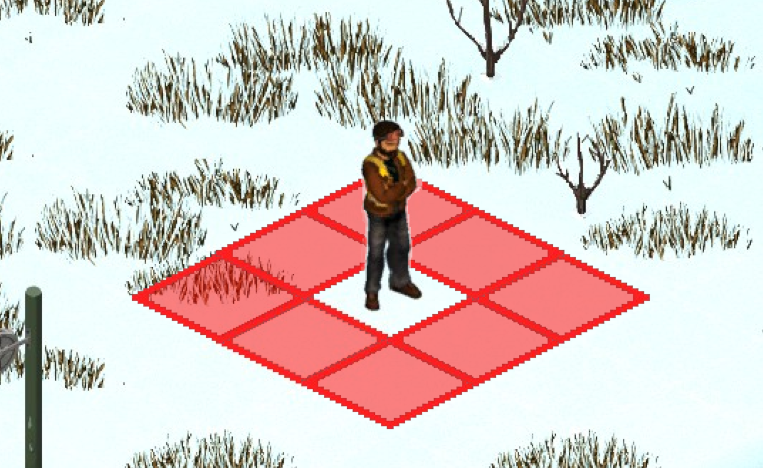
On your turn, if you move from within 1 tile (diagonals included, same floor) of such a fighter to more than 1 tile away.
- In the reach of a Spearwall fighter with a two-handed weapon you carry the Threatened icon and they carry Covering.
- In any other melee fighter's reach you carry In reach and they carry Reaching.
- Each fighter can take only one AoO per turn of yours.
- There is no AoO if you Disengaged this turn or are grappled.
- A fighter who is knocked out, surrendered or offline cannot take an AoO. Knocked-out and surrendered players cannot be targeted by one.
Marking allies
You can stop your attack of opportunity from hitting friends.
- Right-click a name in the turn order and choose Mark as ally. The name then shows (ally) for you.
- Allies never trigger your attack of opportunity, and they do not get the Threatened or In reach icon from you.
- Choose Remove ally mark to undo it. Marking and unmarking is shown in the combat log.
How does it work?
The system handles it all as soon as you step away:
- The fighter rolls a melee attack with their weapon, at -4 unless Spearwall applies. Spearwall's -2 on melee attacks does not apply to this roll.
- You roll Defend (close).
- It is resolved like a normal attack: criticals and defence fumbles apply, and damage is applied automatically.
- You may still complete your movement.
To avoid AoOs, press Disengage before you move (see Disengaging).
Attack of Opportunity Melee Range
☠️ Dice with Death
Dicing with death is the ultimate consequence. When you die in PvP, you Dice with Death. You can always choose to let the death be permanent, or come to an arrangement about other consequences with the other players involved.
- Deaths from PvE (zombies, falls, glitches) are not permanent unless you choose so. (See "Down But Not Out" system for Chapter 3.)
- If your character died in PvP by accident or while complying, they always count as having rolled a 5-6, and you do not need to make a ticket.
- The default when losing PvP is Dicing with Death. You may agree OOC on an alternative with your attackers, but only if all of them agree.
Press Dice with Death (d6) on the rolls panel. In a combat the result goes in the combat log. Outside combat it is shown to everyone within 20 tiles. Thick-Skinned adds +1 unless you roll a 1, and Thin-Skinned takes off 1 unless you roll a 6.
- 1-2: Your character dies of their wounds in the scene. You get no actions after death unless staff or your opponents approve something, such as last words or a dramatic final moment that does not change the result of the scene or reveal your attacker.
- 3-4: Your character only survives if someone with First Aid 6+ treats them within 60 real-life minutes, starting after the whole PvP scene has ended. The medic rolls First aid (d20 + half their First Aid skill level + modifiers): below 15 means severe lasting injuries (such as a permanent negative trait or a scar); 15 or higher means severe temporary injuries you must play out for at least 2 real-life weeks. Involved characters should not actively prevent the rescue.
- 5-6: Your character is unconscious and/or unable to fight. You cannot act while the enemy is present. When they leave, roleplay appropriate injuries.
🧊 Scene Sanctity
- After the PvP initiation emote, everyone at the scene freezes in place. Even if you think you won't be involved, you must stay put.
- No one can join the scene later, and no one can rejoin after leaving.
- Combat happens in the blink of an eye, but with dice it can take much longer. This rule stops people joining who would never have had time to get there, and keeps the scene flowing.
- For story purposes, all parties can agree to lift this, but the agreement must cover everyone joining. That stops one side from letting only their own allies in. It also means all players need to leave combat and restart the combat because there is no way for the system to add a late joiner to an existing combat. All players would need to abide by the new turn order and manually apply any damage from the original combat session.
🚗 Hostile RP with Cars
People inside a car cannot always be heard from outside it (a game bug), so the players involved might not realise PvP has been initiated. Vehicles cannot be used in PvP.
- If someone hits your character with a car, they must get out of the vehicle and state (OOC or IC) that it was a hostile act. The scene starts when the driver gets out, and passengers must also get out promptly if they want to take part. The player who was hit can respond with their own PvP initiation emote, roleplay, or try to de-escalate.
- Drive-by shootings require a management ticket. They can be done with mechanical PvP, purely for flavour and roleplay, with a moderator online to oversee the scene.
- Vehicles do count as cover.
- Car chases: you cannot run someone off the road without the consent of both parties. Vehicle desync means what you see may not be happening on the other player's screen.
🚧 Roadblocks
- Players may build roadblocks and barricades around their base and on the map, but they cannot block a road or path unless they are manned.
- Larger or more permanent blockades need a ticket and staff approval. They must not be very burdensome for others: no unreasonably long detours and no large amounts of loot.
- Not allowed: a road completely blocked with tiles and vehicles that cannot all be removed.
- Allowed: a manned roadblock of tiles and vehicles that others can interact with, and with a way around it via side roads or detours.
- In PvP: a roadblock must actually stop vehicles; if a vehicle can drive past or around it, the driver does not have to stop. The driver must stop and get out OOC so their typing is visible; their character stays inside the vehicle IC.
- Once the vehicle has stopped, the normal combat and escape rules apply. Anyone wanting to rob or attack must initiate PvP. Avoid repeatedly attacking the same players; use Open Communication.